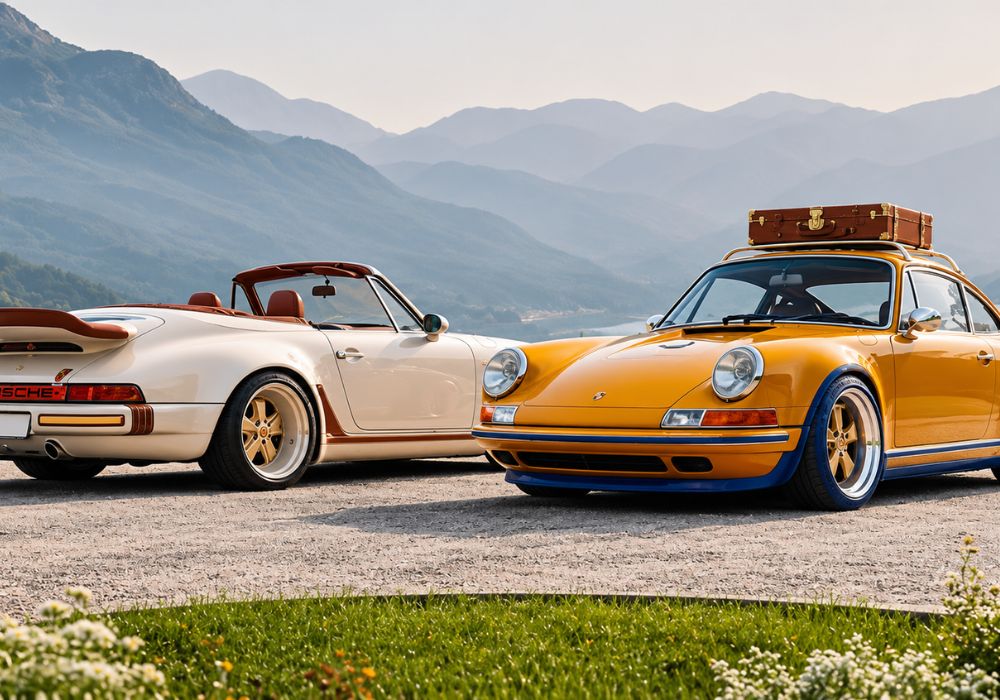
The culture of personalized automobiles finds in the Porsche 911 one of its most recognizable canvases. Its silhouette, barely altered in essence over more than six decades, accommodates reinterpretations that range from historical fidelity to contemporary engineering and artistic expression. In that territory lies a conceptual proposal that brings together three strongly identified universes: the German sports car, Singer Vehicle Design’s restomod philosophy, and Louis Vuitton’s visual codes.
The project imagines what a Porsche 911 would look like reinterpreted with the sensibility of the Californian firm and dressed with aesthetic references from the French house. It is not presented merely as an ornamental customization exercise, but as a dialogue between disciplines that share a particularly close relationship with craftsmanship, precision, and the value of detail.
The result translates to the car an idea akin to haute couture: a recognizable piece, crafted around a concrete identity and conceived to transcend its function. The 911 remains the protagonist, but its bodywork and its visual atmosphere bring it closer to the world of collectible objects.
![]() Few cars possess a formal architecture as immediately identifiable as the Porsche 911. The roofline, the circular headlights, the engine placement, and the balance between compactness and sporty presence have turned its design into a language of its own. That continuity allows each intervention to be measured not only by what it adds, but also by how it respects the original character.
The proposal linked to Louis Vuitton and Singer stems precisely from that tension. On one hand, it preserves the proportions that define the model; on the other, it uses surfaces, colors, and graphic motifs to introduce a reading closer to fashion and high-end leather goods. The car ceases to be understood solely as a machine and becomes also a composition of materials, textures, and cultural references.
This approach is especially coherent with the work associated with Singer Vehicle Design. The company has built its reputation around the restoration and reinterpretation of classic air‑cooled Porsche 911s, combining historical appearance, current technical solutions, and highly customized execution. Its philosophy is not to erase the past but to refine it: preserving the essential traits and reconsidering every component from contemporary standards of quality, performance, and comfort.
In that context, introducing the Louis Vuitton imagery adds a distinct dimension. The influence of fashion does not replace automotive identity, but acts as a second narrative layer.
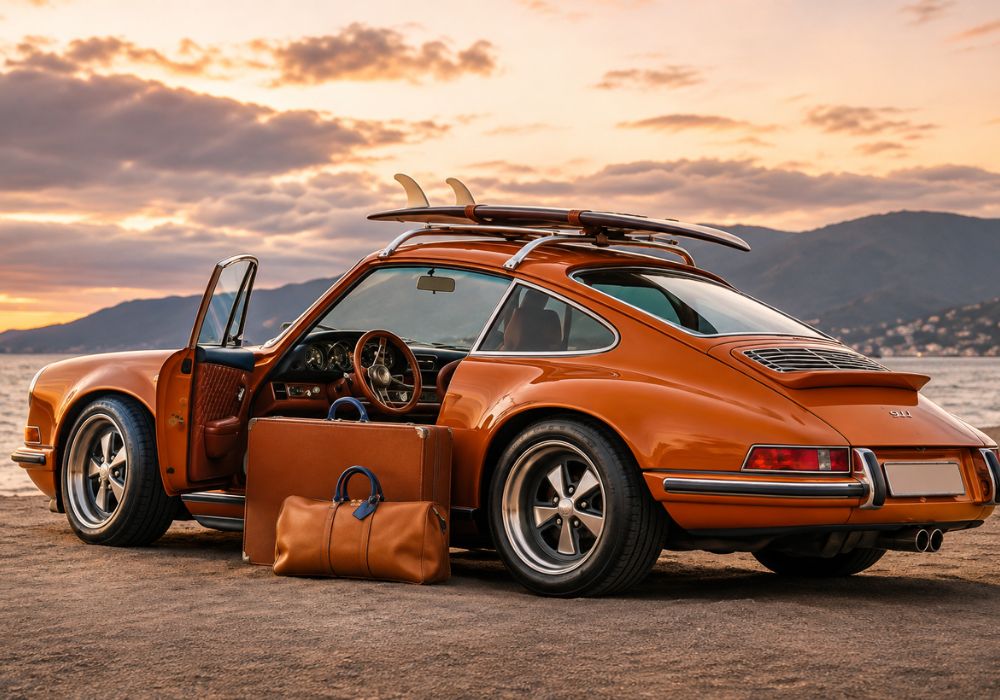 Louis Vuitton’s Monogram motif plays a central role in the project’s visual identity. Created in the late 19th century, this pattern has become one of the most recognizable signs of international fashion. Its presence on luggage, handbags, and travel goods also links it to concepts that belong to the world of grand touring: movement, displacement, durability, and belonging.
Applied to the Porsche 911, the monogram alters the perception of the bodywork. What typically functions as a continuous, aerodynamic surface acquires a graphical quality akin to fabric or a canvas. The vehicle seems wrapped, almost tailored, rather than simply painted.
The color palette deepens that relationship. Browns and golds recall the house’s historic canvas, while darker contrasts reinforce the sports car’s volumes. The combination avoids relying on colors traditionally associated with competition and shifts the focus toward a warmer elegance tied to craftsmanship and travel luggage.
This treatment demonstrates how a brand identity can transform an object without radically changing its structure. The silhouette remains that of a Porsche 911; however, the pattern alters its presence and places it in a territory between automobile, fashion piece, and art object.
Choosing Singer as a reference is no accident. Within the restomod universe, the company represents a particularly rigorous way of approaching customization. Its work is associated with an exhaustive review of air‑cooled Porsche 911s, with attention spanning from the body and chassis to the mechanics, ergonomics, and interior finishes.
The usual starting point for its restorations is the Porsche 911 of the 964 generation, produced from the late 1980s to the mid-1990s. From that base, each car is dismantled and rebuilt according to an individual configuration. The incorporation of contemporary materials and components developed specifically allows reducing weight, improving behavior, and elevating perceived quality without renouncing the analog character that defines these models.
That combination of heritage and innovation brings Singer’s work closer to the logic of a haute couture house. Each commission responds to a particular vision, color and material decisions take on structural importance, and production moves away from standardization. Rather than manufacturing large series, the aim is to build singular pieces around each owner’s preferences.
The Louis Vuitton-inspired concept takes this parallel to an explicit plane. The bodywork functions as the exterior of a bespoke piece, while the finishes imagined for the cabin transfer to the car the tactile dimension proper to leather goods.
![]() The connection between the two disciplines gains particular meaning inside the cabin. If the exterior communicates identity and presence, the interior determines the everyday relationship between the person and the car. Seats, steering wheel, panels, seams, and contact surfaces build an experience that depends on both ergonomics and material quality.
In this reinterpretation, the cabin adopts color and visual references associated with Louis Vuitton. The toasted tones, leather, and artisanal-inspired details create an atmosphere reminiscent of the brand’s historic travel trunks. It is not just about incorporating a logo, but about conveying a certain object culture: materials designed to age with character, functionally executed elements with precision, and an aesthetic capable of preserving its identity over time.
Interior customization also reflects one of the most relevant changes in the contemporary collector car. Performance remains decisive, but shares the spotlight with the provenance of materials, care taken with finishes, and the coherence among all components. The driver is not only seeking performance; they also value the uniqueness of the space they inhabit.
In a classically inspired Porsche 911, that attention is even more important. The cabin is compact and direct, so every texture has an immediate presence. Quality is not perceived from afar but through touch, the position of the controls, and how the different surfaces interact with one another.
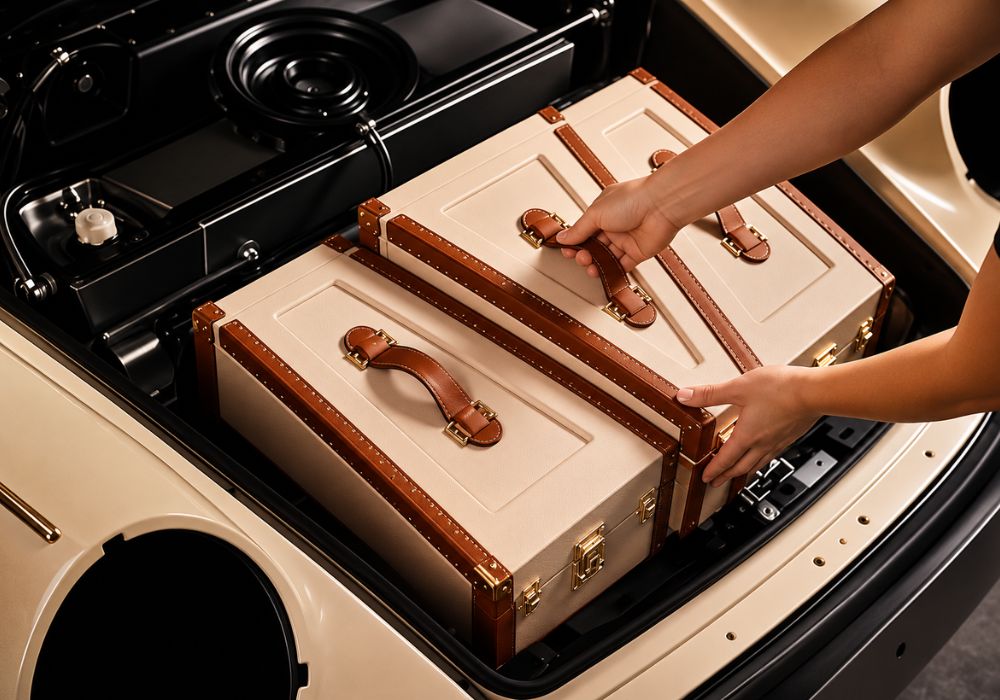 Louis Vuitton’s relationship with travel predates its consolidation as a major fashion house. The firm was founded in Paris in 1854 linked to luggage making, at a time when new means of transport were changing how people moved. Its solutions met concrete needs: protecting belongings, making the most of space, and accompanying increasingly longer journeys.
That heritage makes the automobile a natural territory for a reinterpretation of its codes. Grand touring cars and trunks share the same historical aspiration: to make travel a more comfortable, personal, and refined experience.
The Porsche 911 adds, however, a sporting nuance. It is not a sedan primarily designed for passengers nor a large coupe defined by spaciousness, but a car in which driving takes center stage. Louis Vuitton’s aesthetics thus meet an engineering object whose appeal lies in the connection between machine, road, and driver.
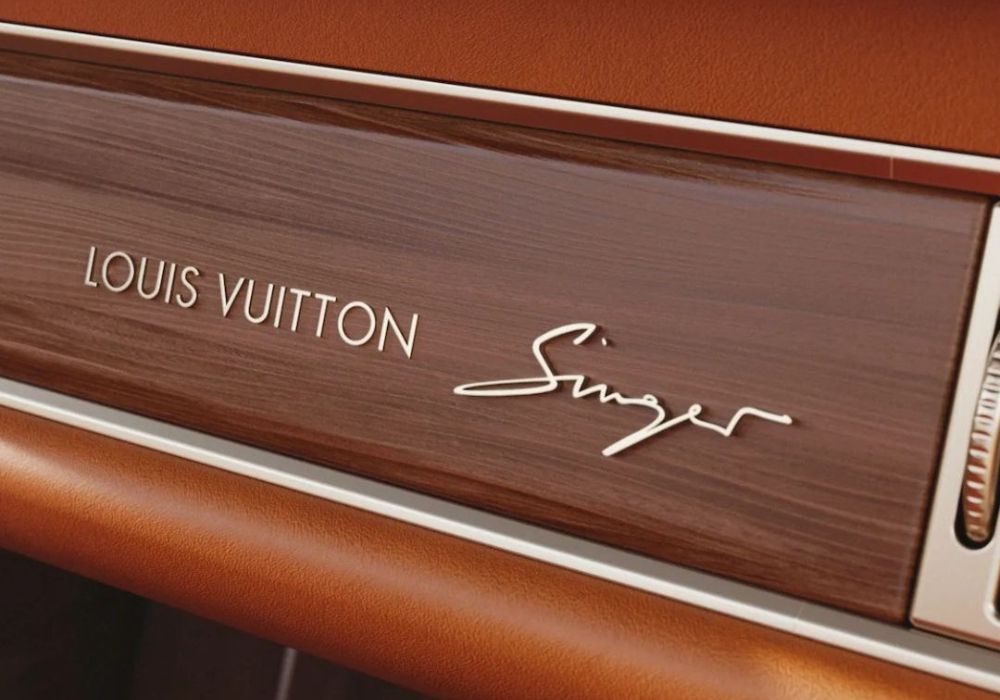 Using such a recognizable monogram can easily be interpreted as an ostentatious gesture. Yet the proposal gains deeper meaning when analyzed as a reflection on the identity of luxury objects. A reinterpretation of a classic Porsche and a handcrafted travel case are valued for their combination of utility, design, materials, and permanence.
The interest lies not only in displaying two well-known names on the same medium. The affinity appears in the way customization is understood and in the importance given to processes that require time and specialization. In both cases, detail ceases to be a secondary finish and becomes an essential part of the product.
There is also an emotional dimension. A restored 911 is not chosen solely for its technical data, just as a historic trunk is not preserved only for its capacity. They are objects capable of accumulating memory, representing a certain sensitivity, and establishing a lasting relationship with their owner.
From this perspective, the concept expresses an evolution of contemporary luxury: exclusivity no longer depends solely on price or scarcity, but on the ability to configure something personal and coherent. Color, upholstery, materials, and cultural references participate in the creation of a piece whose singularity arises from the whole.
The proposal functions above all as a conceptual exercise and not as an announcement of a production model. That condition freely exploring the convergence of Louis Vuitton, Singer, and Porsche, while asking how far personalization of an automotive icon can go without diluting its essence.
German engineering, Californian restomod culture, and Parisian tradition converge in a single image to remind us that the most relevant personalization is not about accumulating elements, but about ensuring that design, materiality, and character form a recognizable narrative.

andBeyond Suyian Lodge: a new expression of private safari in Laikipia
In the northwest of Laikipia, one of Kenya’s most distinctive conservation regions, andBeyond Suyian Lodge offers...