Located on the seventh floor of the Four Seasons Hotel Tokyo at Marunouchi and led by chef Daniel Calvert, SÉZANNE has accumulated major recognitions across 2024 and 2025, placing it at the center of global haute cuisine, with visible effects on premium travel agendas and the competition among culinary capitals.
In Tokyo’s financial district, destination dining has increasingly become a metric for cultural appeal and a city’s ability to attract high-end travelers. In that context, the dining room in Marunouchi offers a compelling case: a French restaurant embedded within the Four Seasons Hotel Tokyo at Marunouchi that nonetheless competes in the international ecosystem of guides and rankings alongside independent projects. The hotel infrastructure provides operational and reputational support, but the restaurant’s performance follows its own logic, executional consistency, narrative clarity, and a dining room capable of translating local demand into global influence.

That trajectory is reflected in the leading prescriptive systems. In the MICHELIN Guide, the restaurant holds the highest distinction, three Michelin stars, supported by a narrative focused on Daniel Calvert’s career path, whose international background is expressed in a proposition that combines French technique with Japanese sensibility. The guide describes a menu built around a fixed format, interpreted through seasonality and a pronounced emphasis on precision in sauces, cooking, and pairings, factors that often shape perceptions of value in fine dining. In parallel, the restaurant has strengthened its profile in the rankings circuit: in The World’s 50 Best Restaurants it stands at No. 7 in 2025 after being No. 15 in 2024; in Asia’s 50 Best Restaurants it was No. 1 in 2024 and appears at No. 4 in 2025, while also being named Japan’s best restaurant in both years.
Beyond the headline numbers, these positions tend to trigger practical consequences in the upper segment of travel and hospitality: increased international demand, longer lead times for reservations, and added pressure on day-to-day service consistency. In destinations such as Japan, where local diners are particularly exacting about repeated standards, the impact of these lists translates into expectations for the restaurant’s “everyday” performance, not only for a single standout visit. For concierge teams and the private-experience industry, the restaurant becomes a programming reference point, comparable to other fine-dining nodes in Paris, Hong Kong, Singapore, or New York.
In October 2025, the hotel ecosystem added another institutional signal: the “Restaurant of the Year 2025” recognition at the Tatler Best Awards, communicated by the hotel group itself. In reputational terms, the award reinforces the link between restaurant and hotel operation: the cuisine is the focal point, but the dining room, the pace of service, and the engineering of hospitality, welcome, timing, detail, and guest follow-up, are often decisive in sustaining a place within the global circuit. This relationship helps explain why certain restaurants inside ultra-luxury hotels can compete independently in international criticism, as long as the culinary identity remains clear and verifiable.

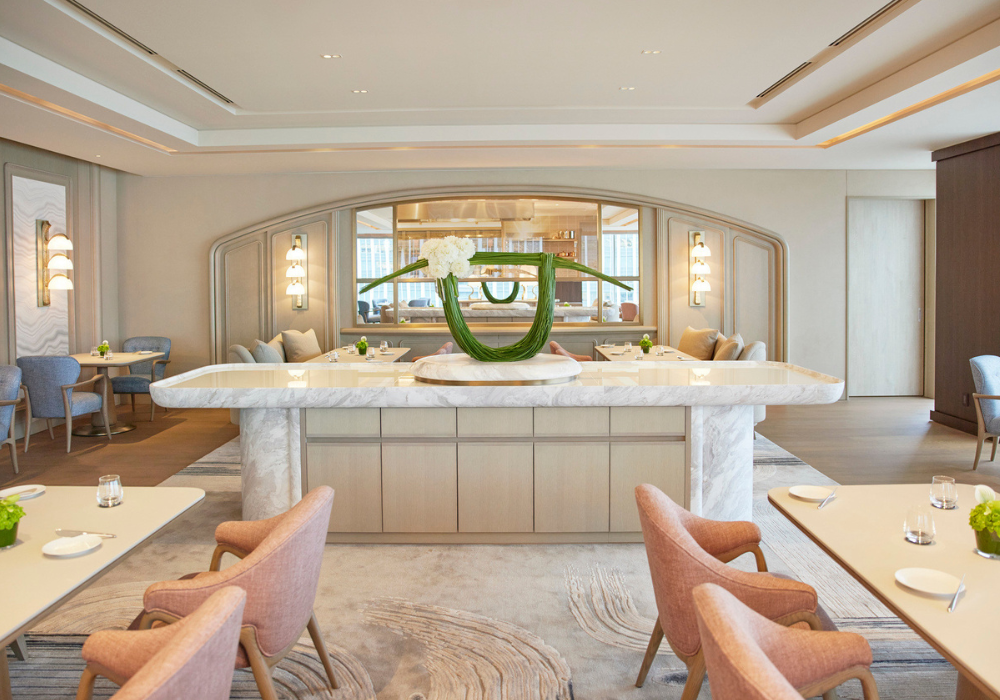
Staging is part of the positioning. The official site describes a dining room with a show kitchen and an interior signed by André Fu, a designer associated with international, high-end hospitality projects. Here, kitchen visibility functions as a language of transparency and technical control, while the design helps consolidate an experience aligned with the standard expected at a table holding the highest distinction. In the luxury universe, these elements do not operate as mere decoration, but as cultural infrastructure: they shape the type of client the restaurant attracts, the tone of service, and how the experience fits into a traveler’s itinerary.
On the culinary side, the narrative rests on a French foundation that incorporates Japanese products and references without diluting method. Guide and ranking profiles often underline that tension: on one hand, classicism and precision; on the other, a local reading of ingredients, fermentations, textures, and seasonality. From an industry perspective, the interest lies in how this balance becomes a distinctive signature that can be understood by different audiences: the local diner who values consistency and detail, and the international visitor seeking a contemporary interpretation of the French repertoire in Tokyo.

The beverage dimension also provides relevant information about positioning. The restaurant’s communication highlights a broad champagne selection and references linked to historic houses such as Maison Krug, alongside the work of the sommelier team. In fine dining, the cellar is not an appendage: it structures part of the average spend, influences the duration of the experience, and places the restaurant within a conversation about brands, vintages, and availability. This layer, combined with the hotel framework, tends to attract private celebrations, corporate visits, and travelers who plan a trip around a specific table.
One symbolic detail captures the project’s logic. In its own narrative, the restaurant mentions a sourdough bread made with white miso and whole-grain koshihikari rice, served with Brittany butter, a combination that, without rhetorical excess, condenses the house thesis on technique, product, and context. In a market where Tokyo competes to capture travel motivated by gastronomy, the Sézanne case shows how a specific address can become an internationally measurable asset through guides, lists, and awards, and how those indicators reorder demand flows in the premium segment without relying solely on novelty.
The Luxury Trends ( Revista de Lujo – Luxury Magazine) © Sézanne imágenes