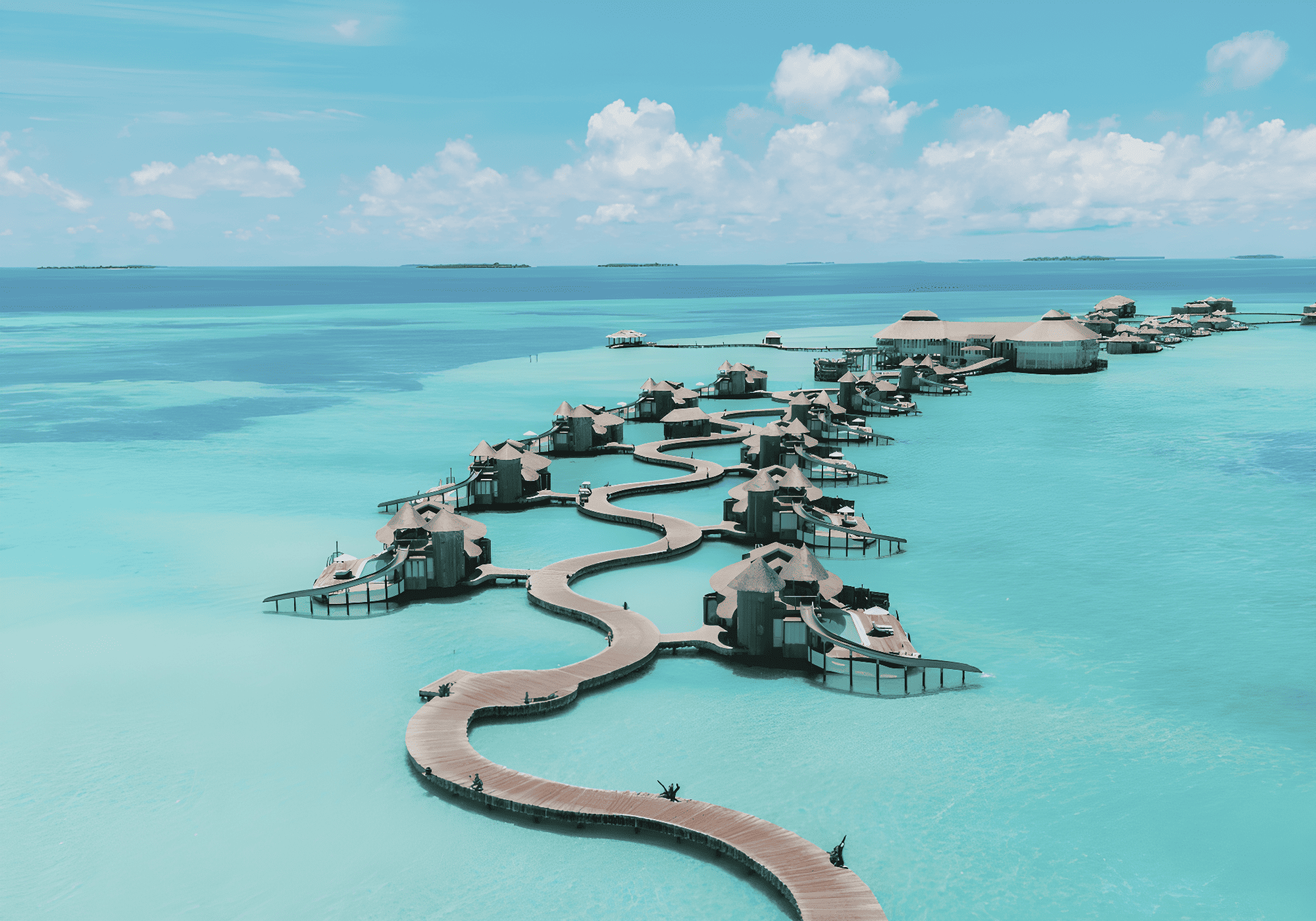
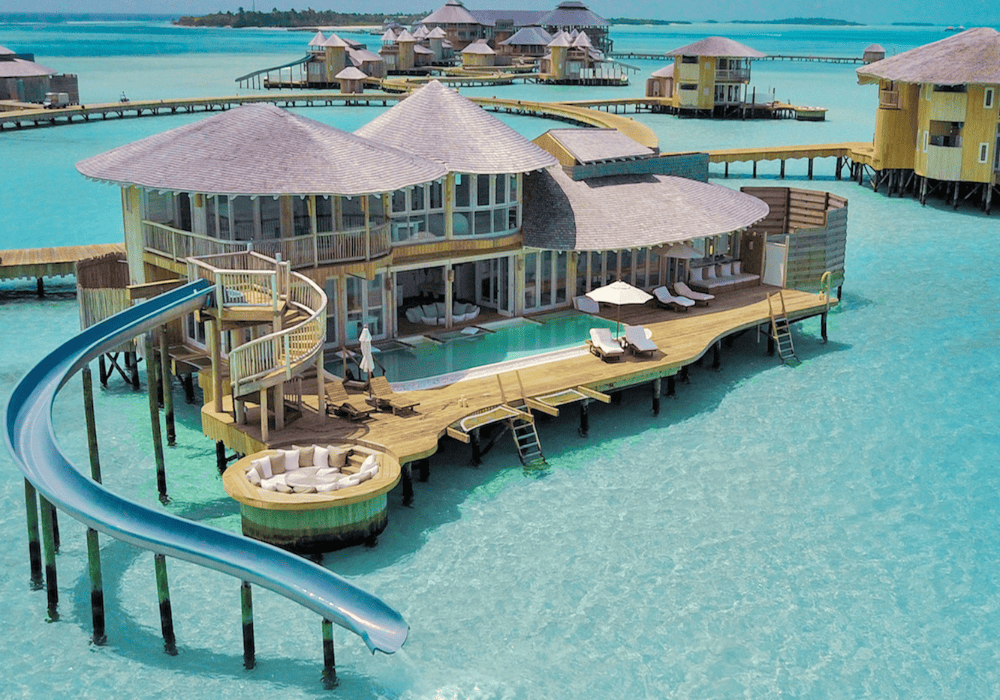
 The accommodation experience draws on a repertoire that has become a hallmark of the Maldivian product, yet with distinctive traits: expansive overwater villas, private pools, and playful elements presented not as add-ons but as part of the functional design. Within its villa portfolio, the resort highlights typologies with retractable roofs that open the bedroom to the night sky and waterslides linking the terrace to the lagoon, alongside differentiated areas for families. These decisions in experiential architecture, combined with the property’s low density, aim to enhance privacy without isolating guests from the life of the resort.
On the culinary front, the resort structures much of its offering around The Gathering, a hub of restaurants and spaces that diversifies formats without fragmenting service. Within that constellation, Overseas by Mathias Dahlgren stands out as one of the names with the strongest international reach: the brand underscores its focus on sustainable seafood and garden produce, alongside a “Chef’s Choice” menu that sequences the experience in courses. The logic is clear: turning the destination into a culinary itinerary, reducing friction for longer stays while widening the range for different profiles, from families to wellness-oriented travellers.
The experiences strategy also functions as reputational infrastructure. Among the most recognisable elements is Cinema Paradiso, an open-air overwater cinema that uses a headphone system to avoid disturbing marine life, an operational decision that connects entertainment with environmental management. In the family segment, the resort highlights The Den, its children’s zone, with references to zip lines and play spaces integrated into a changing programme.
Wellness has gained weight in Soneva’s narrative in recent years, and Soneva Jani integrates it through Soneva Soul, with two spa complexes within the resort and a philosophy that combines complementary therapies, personalised programmes, and the idea of “lifestyle evolution”. This shift aligns with a broader trend in luxury hospitality: guests no longer compare only rooms and restaurants, but also a destination’s ability to deliver rest, healthier habits, and expert guidance throughout the stay.
In parallel, the brand has formalised a model aimed at meeting a growing expectation among premium travellers: reducing spending uncertainty without simplifying the content. Soneva markets Soneva Unlimited as an “unlimited” supplement with a defined time window and a stated price per adult per day, covering meals and beverages, experiences, and treatments at Soneva Soul, alongside related services such as a dedicated assistant. In practice, this formula works as a planning tool for longer stays and multigenerational travel, where predictability can be as relevant as the breadth of activities.
Accessibility, in a destination where the transfer is part of the product, is outlined in detail in official information: arrival can be arranged by seaplane from Malé or by combining a domestic flight to Manafaru with a speedboat transfer, with guidance on schedules and logistics that the resort recommends coordinating in advance. Operationally, this level of specificity is consistent with the clientele it targets: luxury on remote islands demands precision.
The offering is completed by a sustainability narrative that the brand frames within its Slow Life philosophy and practices such as “waste-to-wealth”, alongside waste-management initiatives and community engagement referenced in external and corporate documentation. In 2025, an action linked to the Soneva Foundation and marine conservation is also cited within the Ocean Decade framework, pointing to organisational structures and projects focused on reef regeneration. For the luxury tourism sector, the interest lies not only in the label, but in how these practices translate into daily operations and shape the expectations of international travellers.
Soneva Jani thus brings together three vectors that currently structure the global conversation around luxury hospitality: genuine privacy through low density, experiential programming spanning gastronomy and entertainment, and a layer of wellness and sustainability presented as part of service design. In a market where the Maldives competes to differentiate itself among high-end resorts, the case offers a useful reading: the product is no longer defined solely by the villa, but by the complete architecture of the stay.
The Luxury Trends Magazie (Revista de Lujo – Luxury Magazine) © Soneva Jani imágenes