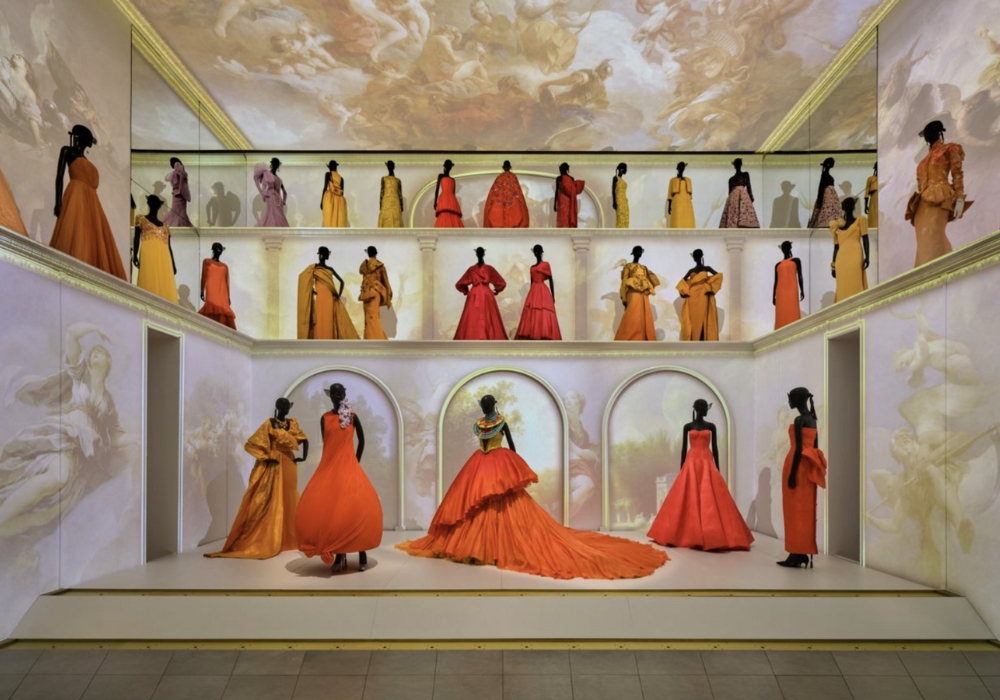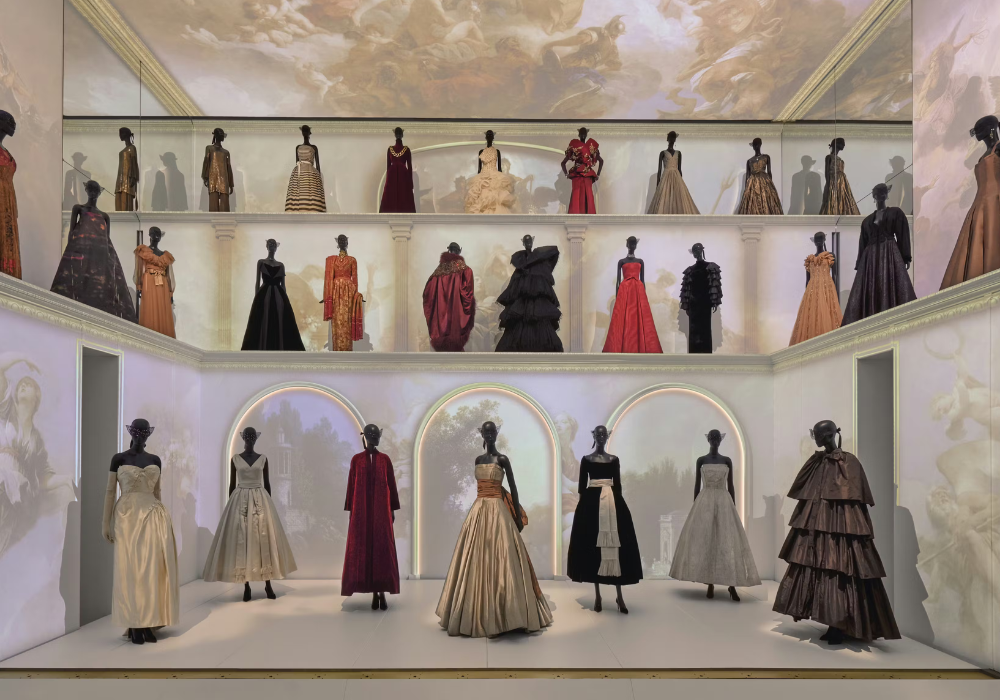
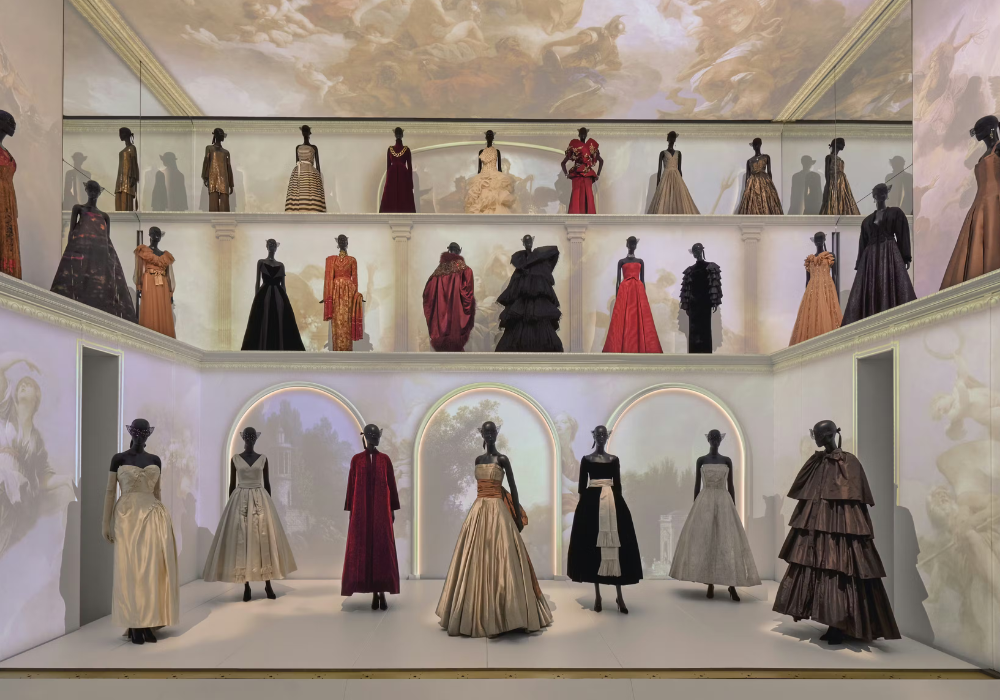
The dual exhibition presents an encounter between two creators whose work shaped the grammar of modern couture. Over several decades, Azzedine Alaïa assembled a significant private archive of Dior garments, treating each design as a document of construction, technique and form. Preserved today by the Fondation Azzedine Alaïa, this material helps trace how couture codes emerged and circulated. The collaboration between both institutions makes it possible to display pieces rarely accessible to the public, including 1950s dresses, early New Look silhouettes, atelier prototypes and garments acquired by Alaïa through international auctions. Their presentation underlines the degree to which Dior’s structural approach informed the Tunisian couturier’s own pursuit of accuracy, balance and proportion.
The project unfolds across two venues that offer complementary readings of the archive. At the Fondation Azzedine Alaïa, the focus lies on the original Dior garments preserved by the designer, allowing an intimate examination of their craftsmanship. The maison’s gallery, by contrast, contextualises this collection through formal dialogues between periods, presenting Dior’s interpretation of its heritage as an evolving cultural resource. This dual strategy highlights a shared commitment to the technical and historical study of haute couture, emphasising pattern-making, fabric manipulation and proportion, elements fundamental to both Dior and Alaïa.
Alaïa’s admiration for Christian Dior becomes evident through the garments selected for the exhibition. Known for his mastery of volume and his analytical reading of the body, Alaïa considered Dior a central reference in the development of the modern silhouette. His private collection, assembled over more than three decades, includes structured satins, expansive skirts, moulded necklines and internal constructions that reflect the architectural nature of mid-century couture. Exhibiting these ensembles together demonstrates the coherence of their creative languages and the influence both couturiers exerted on fashion history. It also highlights how each approached couture as a discipline grounded in method, continuity and technical depth.
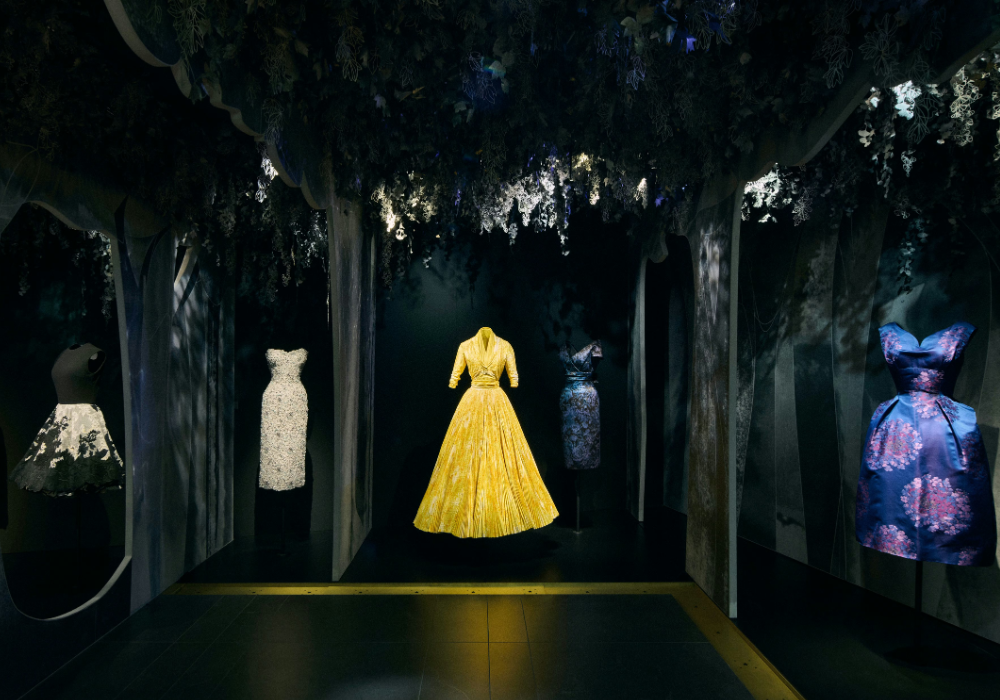
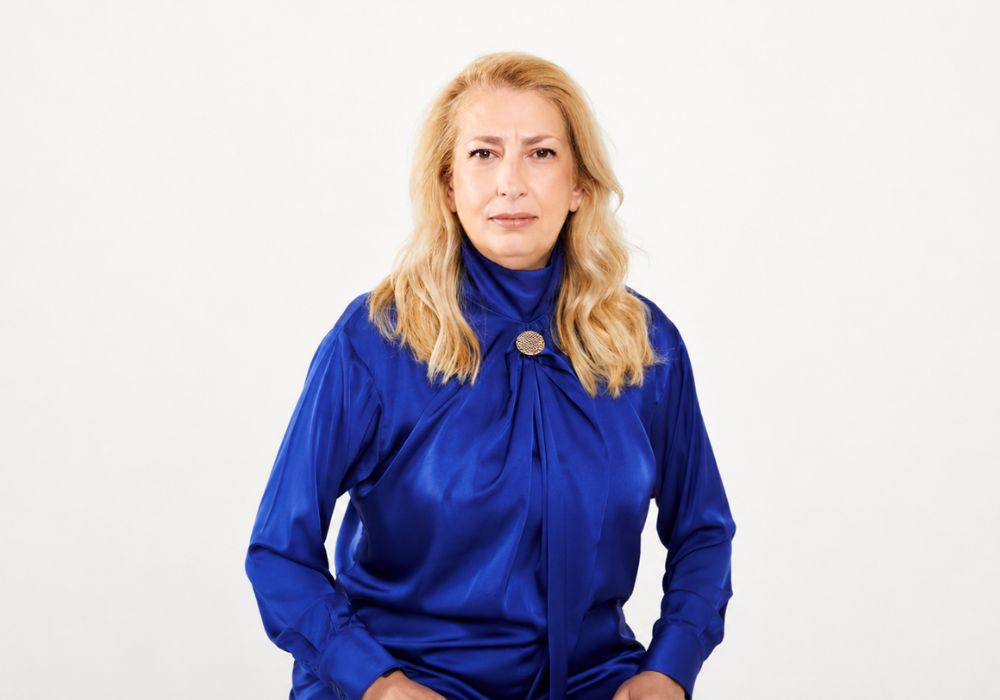
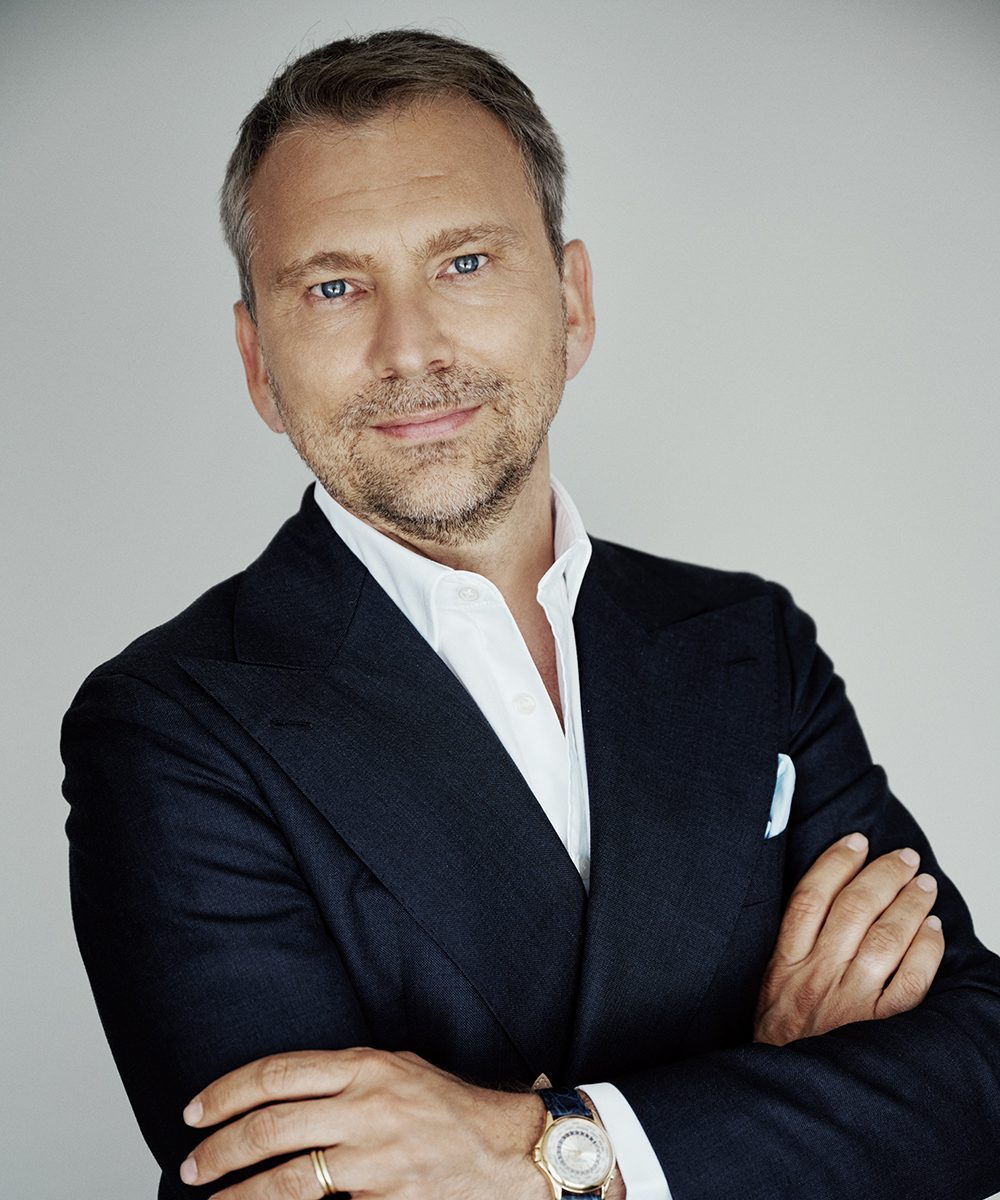
Alongside the garments, the exhibition incorporates original archival material that expands the historical narrative: restored photographs, workshop notes and correspondence conserved by the Fondation. These documents provide insight into the methodological precision that defined Dior’s early years and Alaïa’s curatorial practices. They also underline the contributions of collaborators such as Silvia Venturini Fendi and Pieter Mulier, who have supported projects committed to research and heritage preservation. Their participation situates the initiative within a broader network of institutional partnerships that sustain the cultural study of luxury craftsmanship. Dior’s involvement reflects its intention to consolidate its presence in the museum sphere and to strengthen the role of archives in creative development.
The exhibition has drawn significant international attention from museums, collectors and specialists in couture studies. Many regard this dialogue between Dior and Alaïa as a valuable contribution to the understanding of European textile craftsmanship. The presence of restored pieces in a long-term curatorial context allows for a rigorous examination of techniques essential to the preservation of couture heritage. This collaboration also offers a framework for future exhibitions dedicated to designers whose work shaped the evolution of contemporary aesthetics, at a moment when archives are increasingly recognised as strategic tools for interpreting the mechanisms that define luxury creation.
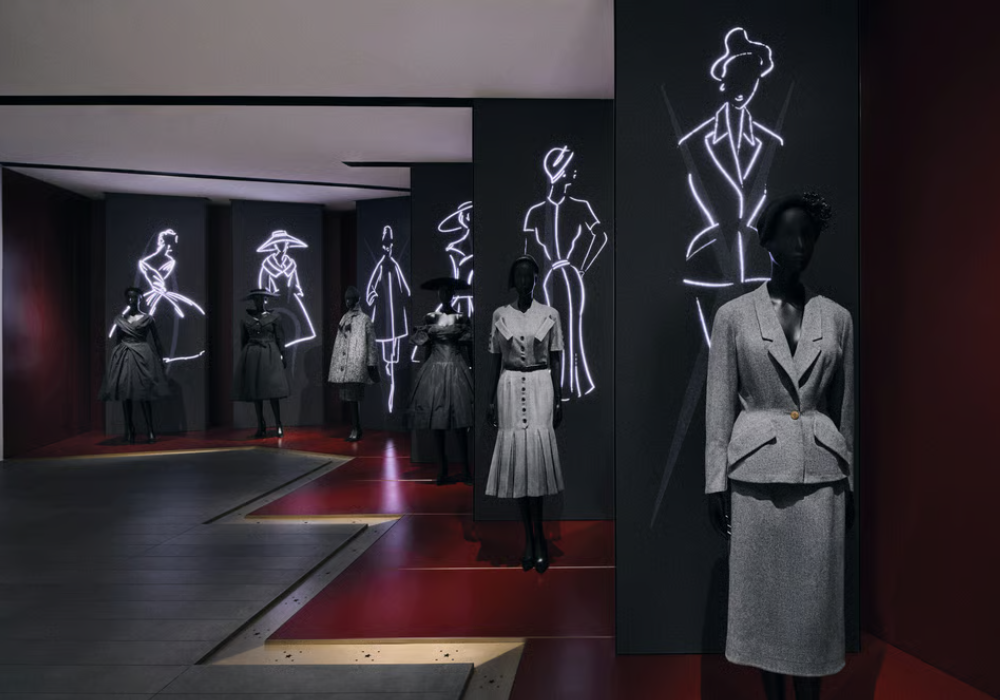
In an industry marked by accelerated cycles, the project encourages reflection on the lasting cultural significance of couture. Presenting garments created more than half a century ago illustrates how fundamental principles, pattern engineering, structural craftsmanship, precision of cut and material research, continue to inform contemporary practice. Both institutions underscore the importance of safeguarding this knowledge to ensure that future generations can access the technical and cultural foundations of couture. This approach aligns with broader initiatives within the sector that position archives as key instruments for innovation and research.
With this initiative, Paris reinforces its role as a cultural capital of luxury, articulating a dialogue between past and present that enriches the understanding of fashion as both art and historical expression. The dual exhibition situates Dior and Alaïa within a shared continuum, tracing how their visions contributed to the architectural vocabulary of couture. For institutions, researchers and industry experts, the project represents a significant milestone, opening pathways for further investigations into the relationship between atelier practice, creative legacy and the preservation of cultural memory. Its value lies not only in the exceptional range of works displayed but also in the clarity with which it articulates the dialogue between tradition and innovation
From The Luxury Trends Magazine (Luxury Magazine – Revista de Lujo), we would like to thank LVMH for the images. ©LVMH.